

 Polski
 Deutsch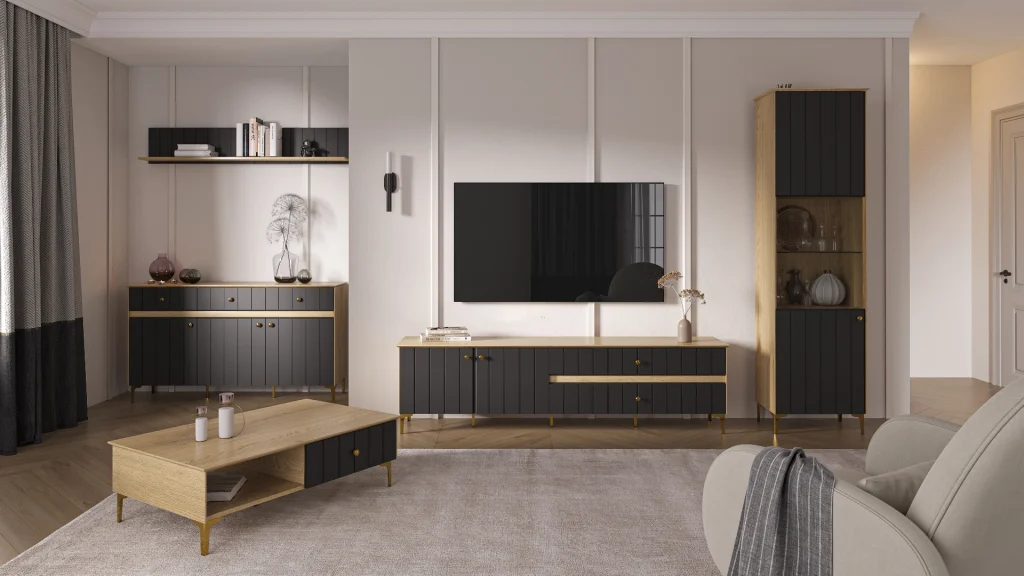
Calculating ROI: Why Procurement Chooses Fabryka Mebli Blonski
For a professional buyer, furniture is not décor but a long-term capital allocation decision. Fabryka Mebli Blonski offers a combination of durability, modularity, and commercial flexibility that improves total ROI compared to many mid-price analogues in the European mass-market segment.
What ROI Means for Furniture Procurement
Procurement leaders rarely buy on unit price alone; they evaluate the total cost of ownership and impact on revenue. For furniture, ROI can be framed simply.
- Basic logic: ROI ≈ (Financial benefits over lifecycle − Total lifecycle costs) ÷ Total lifecycle costs, where benefits include extended service life, fewer replacements, higher occupancy or sales, and lower downtime.
- Lifecycle costs include purchase price, delivery and installation, maintenance, repairs, replacements, and disposal or reconfiguration expenses.
- For retailers, developers, and operators, furniture that better supports modern living trends (compactness, modularity, sustainable materials) can directly influence conversion rates, occupancy, and customer satisfaction.
How Fabryka Mebli Blonski Improves the Numerator: More Financial Benefit
Blonski’s current portfolio is designed around trends that drive commercial performance: compact layouts, modular systems, and “warm minimalism” that sells well online and offline.
- Compact and modular collections optimized for small apartments and rental formats help retailers sell ready “room packages,” and operators furnish units faster, which accelerates revenue generation and reduces vacancy days.
- Consistent modern aesthetics (natural textures, warm neutrals, soft forms) match dominant European demand patterns, increasing sell-through for retailers and perceived value in rental and hospitality projects.
- Flexible, multi-scenario furniture (e.g., modular walls, convertible units, storage-optimizing systems) supports the “1 set — multiple use cases” approach, which allows operators to adapt spaces to different tenant types without full refits.
How Fabryka Mebli Blonski Reduces the Denominator: Lower Lifecycle Cost
From a cost perspective, procurement benefits when each euro spent produces more service hours and fewer interventions. Blonski’s industrial model and product design support this.
- Self-assembled case furniture with standardized components simplifies logistics, warehousing, and replacement of individual elements, reducing both transport and service costs versus fully bespoke or non-modular sets.
- Industrialized, repeatable collections for multiple markets (Poland, Germany, wider EU) mean stable quality and predictable performance, which translates into fewer warranty cases and less operational disruption.
- The ability to reconfigure or extend modular systems instead of replacing entire rooms reduces capital expenditure during format changes, concept updates, or tenant rotations.
Strategic Advantages for Procurement Teams
For a buyer, a reliable manufacturer is a risk-mitigation factor, not just a supplier. Blonski’s positioning gives procurement a stronger business case when choosing it over anonymous analogues.
- In-house design and production allow quick adaptation of collections for specific retail chains or property portfolios without changing the production base, which lowers development risk and speeds up time-to-market.
- The option to co-develop exclusive modular lines aligned with current European trends gives retailers and large buyers differentiation without building their own product development infrastructure.
- For procurement, this means a vendor who can support multi-country rollouts, consistent assortments, and scalable concepts, making long-term ROI more predictable and easier to justify internally.
How to Present the ROI Case Internally
When presenting Fabryka Mebli Blonski as a preferred vendor, procurement can frame the decision with clear, quantifiable arguments.
- Compare scenarios: (a) lower upfront cost, shorter service life, frequent replacements vs. (b) Fabryka Mebli Blonski modular systems with longer lifecycle, higher adaptability, and fewer refits; emphasize savings on replacement, downtime, and installation.
- Highlight revenue effects: faster furnishing of new units or stores, better alignment with proven European demand trends, and higher customer satisfaction scores tied to functional, modern interiors.
- Underline risk reduction: a European manufacturer with stable industrial capacity, trend-aligned collections, and customization options is easier to integrate into long-term sourcing strategies than fragmented local analogues.
If you are responsible for sourcing furniture for retail, rental, or hospitality projects, let’s discuss how Blonski’s modular systems can improve the ROI of your next roll-out.