

 Polski
 Deutsch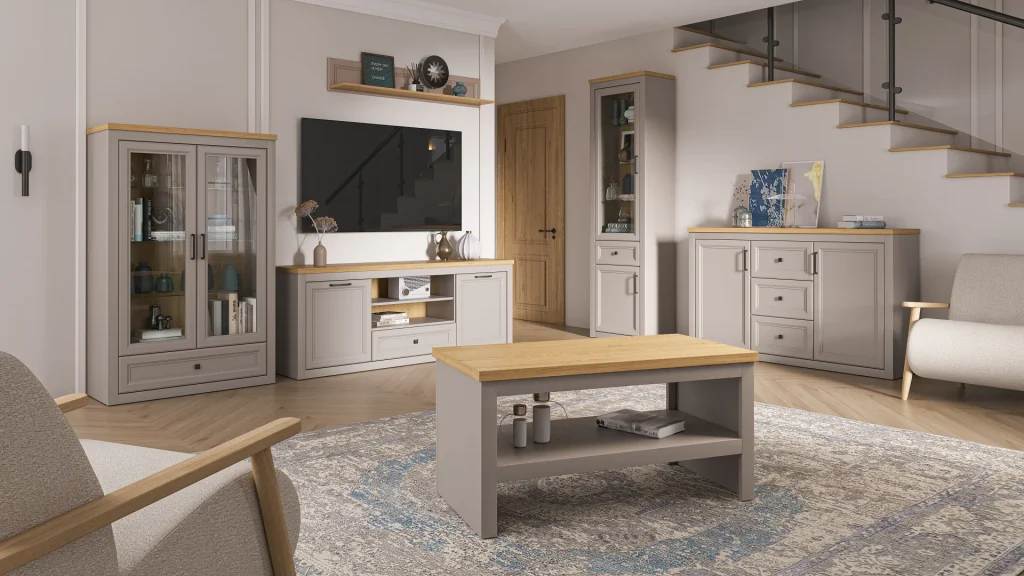
Modularity is quickly becoming the default setting for modern interiors, not an exotic option. Flexible furniture systems let spaces evolve together with people, instead of forcing people to adapt to static layouts.
Why Static Furniture Feels Outdated
Life is no longer “one layout for 10 years” – people move, switch jobs, work from home, launch side projects, and turn living rooms into offices overnight.
- Fixed furniture turns every change into a problem that costs money, time, and nerves.
- Bulky wall units and non-flexible sets are hard to scale, hard to move, and almost impossible to reuse in new scenarios.
- Modularity solves this: you can rearrange, swap, and add blocks rather than start from scratch each time.
Modularity as Everyday Flexibility
Modular systems are essentially “furniture LEGO for adults” – same logic, more style.
- You can begin with a minimal set (for example, basic storage + TV unit) and grow the system as your space or budget expands.
- Changing functions is easy: what started as a living room composition can be rearranged into a home office or guest area using the same modules.
- Instead of a single “correct” configuration, you get multiple scenarios that adapt to seasons, tenants, or new life stages.
Benefits for Modern Homes and Rentals
For homeowners, tenants, and landlords, modular furniture is less about décor and more about managing change smartly.
- Moving to a new apartment does not mean selling everything; modules can be reassembled under a new layout, saving money and reducing waste.
- Landlords can refurnish units for different target audiences (student, couple, young family) by reconfiguring the same system.
- In compact urban spaces, vertical and modular storage helps avoid visual clutter while using every centimeter efficiently.
Why Businesses Love Flexible Systems
For co-working spaces, colivings, hotels, and showrooms, modularity is a tool for speed and scalability.
- Opening a new location becomes faster when you can replicate a concept using tried-and-tested modular sets instead of designing from scratch.
- Rebranding or changing the format requires fewer investments: you can adjust zoning, storage, and focal points with minimal new purchases.
- Modular elements simplify maintenance – damaged fronts or modules are replaced piece by piece, not as entire sets.
Modularity as the New Standard
In a world where everything is updating — from apps to business models — furniture is finally catching up. Modular systems turn interiors into living systems instead of fixed installations.
- For individuals, this is freedom to experiment without fear of “getting it wrong once and forever”.
- For businesses, it is a practical way to keep spaces aligned with strategy, not stuck in the last decade’s format.
- In both cases, modularity is less a trend and more a new baseline: a smart standard for any space that expects to change.